
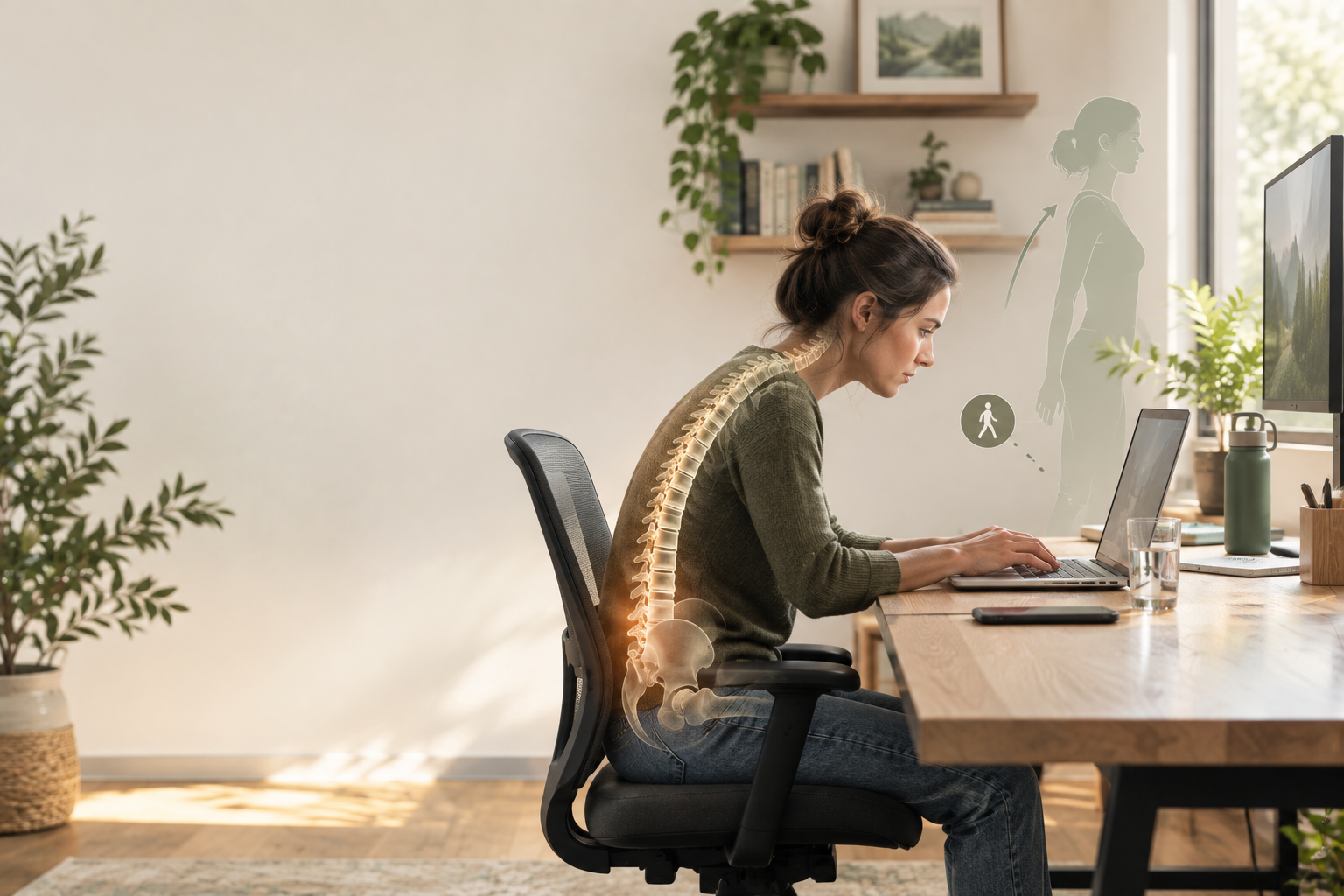
Rochester has a strong and growing base of office workers, remote professionals, healthcare employees, and students — many of whom spend the majority of their waking hours seated. If you're one of them, and you've noticed increasing stiffness in your neck, aching in your lower back, or headaches that seem to appear reliably around 3pm, there's a very specific reason for that. And the good news is, it's addressable.
What Actually Happens to Your Spine When You Sit
The human spine is not designed for prolonged static loading. When you sit — especially with a forward head posture looking at a screen — a cascade of biomechanical changes occurs:
- Disc compression increases. Intradiscal pressure is actually higher when sitting than when standing. Over time, this can accelerate disc degeneration and contribute to disc bulges or herniations.
- Hip flexors shorten and tighten. The psoas and iliacus muscles, which connect your spine to your femur, adaptively shorten when held in a flexed position for hours. This pulls your lumbar spine forward and contributes to lower back pain and poor movement patterns.
- Glutes inhibit. Sitting essentially "turns off" your gluteal muscles — the primary stabilizers of your pelvis and lower back. Weak, inhibited glutes force your lower back to compensate, contributing to chronic strain.
- Forward head posture loads the cervical spine. For every inch your head moves forward of your shoulders, the effective weight on your cervical spine increases by roughly 10 pounds. At a moderate forward head position, that's an additional 30–40 lbs of force on the joints and muscles of your neck — all day, every day.
The Warning Signs to Watch For
These structural changes don't happen overnight, but they accumulate. The early warning signs include:
- Stiffness or aching in the lower back, especially after long periods of sitting or upon standing
- Tension headaches originating at the base of the skull
- Tightness or reduced range of motion when turning your head
- Burning or fatigue between the shoulder blades
- Numbness or tingling in the hands or fingers
If any of these are familiar, they're worth taking seriously — not just managing with ibuprofen and hoping they pass.
What You Can Do Right Now
Set a Movement Alarm
The single highest-impact change most desk workers can make is simply standing up and moving every 30–45 minutes. Even a 2-minute walk to get water or do a few gentle neck rotations interrupts the static loading cycle. Set a recurring reminder on your phone or computer.
Audit Your Workstation
Your monitor should be at eye level so your head isn't tilting down. Your chair height should allow your hips and knees to be at roughly 90 degrees with feet flat on the floor. Your keyboard and mouse should be close enough that your shoulders aren't rounded forward. These aren't luxury adjustments — they're biomechanical necessities for anyone spending significant time at a desk.
Strengthen the Right Muscles
Hip flexor stretching, glute activation exercises, and deep neck flexor strengthening are the three most important corrective targets for desk workers. A customized exercise programming plan can address your specific patterns — we build these as part of chiropractic care at Oak & Olive so that your progress between visits sticks.
Get a Chiropractic Evaluation
If you've already accumulated significant postural strain, spinal joint restrictions, or muscle imbalances, self-care alone has limits. Chiropractic manipulative therapy restores mobility to restricted spinal segments, instrument-assisted soft-tissue mobilization addresses the fascial and muscular components, and a structured treatment plan can reverse patterns that years of desk work have created.
Many of our patients at Oak & Olive Chiropractic are Rochester-area professionals who came in for back or neck pain and discovered that a targeted plan — combining chiropractic care with exercise programming and soft-tissue work — made a bigger difference than anything they'd tried before. If that sounds like you, book a consultation and let's take a look at what's going on.